


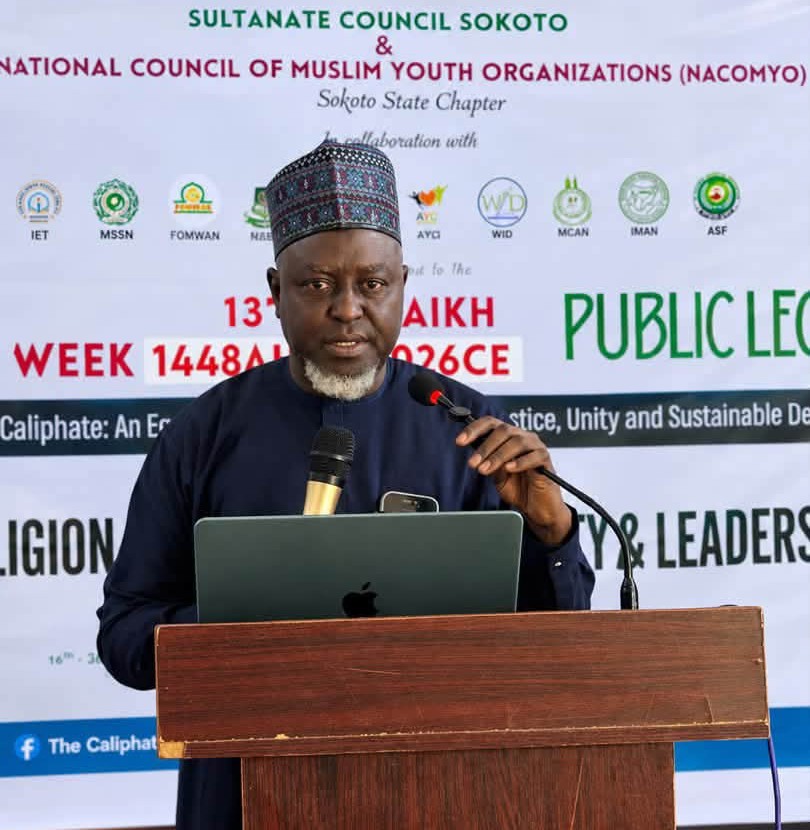
Scholars have highlighted the enduring relevance of the Sokoto Caliphate’s principles of leadership, justice, public accountability and security in addressing contemporary challenges facing society.
They made the observations on Thursday during the third day of the 13th Sheikh Usmanu Bin Fodiyo Week 2026, held at the Islamic Education Trust (IET) Hall, Sokoto, where they examined the historical foundations of the Caliphate and their application to modern governance and security challenges.
The first lecture, titled “Leadership, Justice and Public Trust: Sultan Muhammad Bello’s Legacy in Theory and Practice and its Relevance to the Contemporary Ummah,” was delivered by the Vice-Chancellor of Northwest University Sokoto, Prof. Mukhtar Umar Bunza.
Bunza examined the leadership philosophy of Sultan Muhammad Bello, highlighting his commitment to justice, accountability and responsible governance as principles that remain relevant to contemporary society.
Another presentation, delivered by Imam Mukhtar Abdullahi, Walin Gwandu, focused on “Tsare Rayuka da Dukiya a Daular Usmaniyya: Tsare-tsare da Dabarun Shehu da Magadansa, da Darussa don Magance Matsalolin Tsaro a Ƙarni na 21.”
The lecture examined the security structures established by Shehu Usmanu Danfodiyo and his successors to protect lives and property, drawing lessons from their strategies for addressing present-day security challenges.
Prof. Abubakar Usman Ribah, Assistant Commandant of HISBA, served as the discussant.
The programme also featured two lectures by Dr. Sa’idu Ahmad Dukawa of Kano on the application of the lessons of the Danfodiyo Jihad in the modern era and the diplomatic and cooperative relations between the Sokoto Caliphate and other empires.
Dukawa highlighted the Caliphate’s historical engagement with other political entities, emphasising the relevance of diplomacy, mutual understanding and cooperation to contemporary governance and international relations.
The sessions were chaired by Prof. Attahiru Muhammad Sifawa, Commissioner for Science and Technology, Sokoto State.
The third-day lectures attracted scholars, students and other participants, with discussions centred on how the intellectual, political and administrative heritage of the Sokoto Caliphate could inform responses to present-day societal challenges.
